

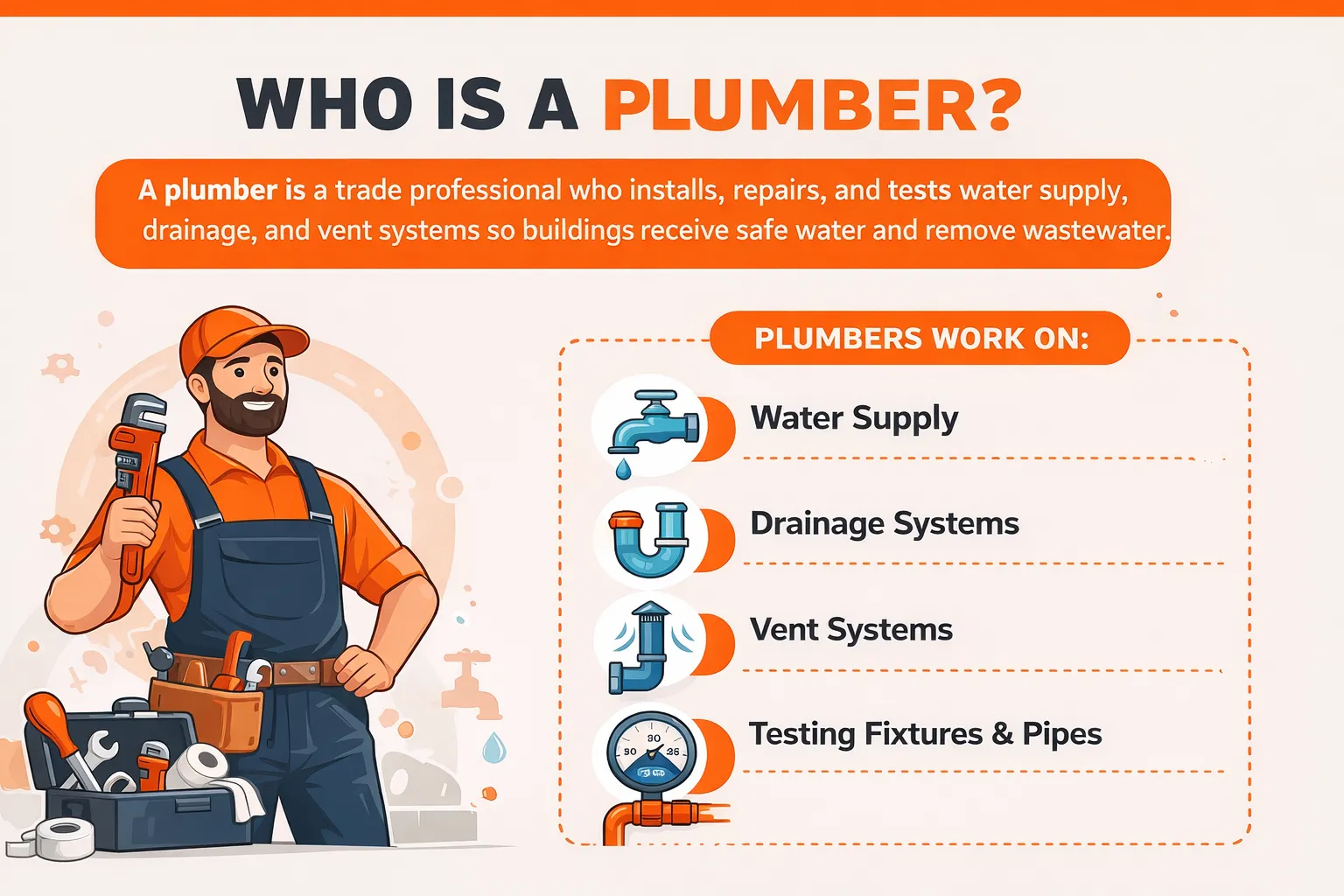
A plumber is a trade professional who installs, repairs, and tests water supply, drainage, and vent systems so buildings receive safe water and remove wastewater. In the Philippines, Republic Act No. 1378 and PRC describe plumbing work as consultation, design, installation, supervision, inspection, and acceptance of materials used for drainage, venting, and hot or cold water supply systems.
Plumbers work in homes and in high-occupancy buildings, use hand tools and test tools, follow safety rules for hazards such as confined spaces and trenches, and train through formal courses and job-site practice.
Common code-based checks include limiting static water pressure to 80 psi 552 kPa and maintaining minimum drain slopes such as 1/4 inch per foot for smaller drain pipe. Metro Manila salary estimates reported on major job and pay platforms cluster near PHP 19,000 to PHP 21,000 per month for posted jobs, with Manila-area averages reported near PHP 18,874 per month.
The later sections cover plumber types, core skills, common tools, measurable benefits and risks, a step path to become a plumber, a hiring checklist, and the warning signs that justify a service call, including Metro Manila Plumbing contact by email.
Who Is A Plumber?
A plumber is a trained worker who installs and maintains piping, fixtures, and related equipment used for water supply and sanitation inside buildings and on sites. Republic Act No. 1378 describes plumbing practice as work that covers storm and sanitary drainage, venting of fixtures, and hot or cold water supply systems, plus inspection and acceptance of materials used. Professional Regulation Commission
The English word “plumber” comes from Latin “plumbum,” meaning lead, because early pipework and roof drainage used lead as a common metal. Merriam-Webster records “dealer or worker in lead” as the older sense, and Etymonline links “plumber” to Latin “plumbarius,” a worker in lead. Merriam-Webster
What Is The Work Of A Plumber?
The work of a plumber is to deliver potable water to points of use and move wastewater safely to a sewer, septic tank, or other approved terminal. Republic Act No. 1378 lists storm and sanitary drainage, sanitary venting of fixtures, and hot or cold water supply systems as core areas of plumbing practice. Professional Regulation Commission
A plumber completes that work through a repeatable process:
Inspect the site and identify the fault or the installation route.
Isolate water or gas service at the proper valve.
Remove failed parts and prepare pipe ends.
Assemble new pipe runs and connect fixtures using code-accepted joining methods.
Test the system with pressure, flow, or drainage checks.
Document test results and restore service.
Two code-based numeric examples describe plumbing “working rules”:
Static water pressure control: The 2024 International Plumbing Code states that when static pressure exceeds 80 psi 552 kPa, an approved pressure-reducing valve is installed to reduce building distribution pressure to not greater than 80 psi static. ICC Digital Codes
Drain slope control: International Plumbing Code Table 704.1 sets minimum slope at 1/4 inch per foot for 2 1/2 inch drain pipe and smaller, and 1/8 inch per foot for 3 to 6 inch pipe. ICC Digital Codes
Hot water safety is part of plumbing work. The U.S. Consumer Product Safety Commission notes that a 120°F 49°C thermostat setting may be necessary to reduce the risk of many tap-water scald injuries, and ASSE literature flags point-of-use temperatures over 120°F 49°C as a hazard. U.S. Consumer Product Safety Commission
Safe water and sanitation are public-health basics. World Health Organization water, sanitation, and health guidance states that safe drinking-water, sanitation, and hygiene are crucial to health and well-being. World Health Organization
What Does A Residential Plumber Do?
A residential plumber installs and repairs plumbing systems in houses, apartments, and small residential buildings. Residential work concentrates on fixtures and short pipe runs that feed bathrooms, kitchens, and laundry areas.
Common residential task areas include:
Toilets, taps, showers, sinks, and floor drains
Water heaters, storage tanks, and temperature-mixing valves
Water supply branches, fixture shutoffs, and branch valves
Drain-waste-vent pipe, traps, cleanouts, and vent connections
Small pumps and pressure control parts in properties with tanks
Typical pipe sizes in homes provide a useful reference:
Supply branches often use 1/2 inch, with 3/4 inch for a main run or a high-demand branch.
Fixture drains often use 1 1/4 inch to 2 inch, with 3 inch or 4 inch for a toilet discharge line.
What Does A Commercial Plumber Do?
A commercial plumber installs and maintains plumbing systems in offices, malls, schools, hospitals, hotels, and industrial buildings. Commercial work deals with higher fixture counts, larger pipes, higher peak flow, and more inspection records than many small residential jobs.
Commercial plumbing commonly includes:
Backflow prevention and cross-connection control for potable water safety
Booster pumps, storage tanks, pressure zones, and pressure regulation
Grease interceptors, floor drains, and higher-capacity sanitary drainage
Permit inspections, test records, and planned maintenance tasks
The U.S. Environmental Protection Agency describes backflow as an unintended reversal of flow through a cross-connection, with potential to introduce contaminants into drinking water systems, which is why cross-connection control and backflow prevention programs exist. US EPA
What Skills Must A Plumber Have?
A plumber must have code literacy, hands-on installation skill, diagnostic skill, and safety discipline that match regulated work. Skills group well into six practical categories:
Code and plan reading: Interpret drawings, fixture layouts, and specifications; match work to local code.
Measurement and layout: Measure pipe runs accurately; mark slope and support spacing.
Pipe joining methods: Use soldering, solvent welding, threaded joints, compression fittings, and crimp systems depending on material.
Diagnostics and testing: Use gauges and test pumps to verify pressure limits; confirm drainage flow and vent function.
Safety controls: Apply confined-space rules, hot-work controls, chemical handling, and site barricades.
Documentation: Record materials, scope changes, and test readings; write clear handover notes.
Philippine training standards capture many of these skills in formal competency units. The TESDA Plumbing NC II training regulations amended and promulgated in October 2014 describe competencies for multi-unit plumbing installation, repair and maintenance work, estimation, mensuration, and pipe system testing. The TESDA document references a 40-hour construction safety training course aligned with Department Order No. 13 s. 1998 for construction safety and health. Tesda
What Types Of Plumbers Are There?
Types of plumbers are usually grouped by work setting and the systems handled. Common types include:
Residential service plumber: Home repairs, fixture replacement, small upgrades.
Commercial plumber: Larger buildings, higher fixture counts, higher compliance.
Construction plumber: New build rough-in, fit-out, and turnover testing.
Industrial plumber: Plant utilities, process-support piping, equipment tie-ins.
Drain and sewer specialist: Sewer lines, cleanouts, drain clearing, camera checks.
Gas plumber: Fuel-gas piping installation and testing where regulated.
Licensing titles and scope differ by country. In the Philippines, PRC describes the Board for Master Plumbers created under Republic Act No. 1378, and PRC records the National Plumbing Code of the Philippines history, including a Revised Plumbing Code adopted in 1999 under the law. Professional Regulation Commission
What Tools Do Plumbers Use Most Often?
Plumbers use gripping tools, cutting tools, measuring tools, and test tools to complete installation and repair work. The table below lists common tools with typical size ranges used in field work.
| Tool | Typical size or range | Primary use |
|---|---|---|
| Pipe wrench | 10 to 24 inch | Turn threaded pipe and fittings |
| Adjustable wrench | 6 to 12 inch | Tighten compression nuts and valves |
| Tongue-and-groove pliers | 10 inch | Grip traps, nuts, and fittings |
| Basin wrench | 11 to 17 inch reach | Reach faucet nuts under sinks |
| Tubing cutter | 1/8 to 1 1/8 inch | Cut copper tube square |
| Hacksaw | 12 inch blade | Cut plastic pipe and small metal pipe |
| PEX crimp tool | 3/8 to 1 inch | Crimp PEX rings |
| Manual drain auger | 25 to 50 ft cable | Clear clogs in branch drains |
| Pressure gauge | 0 to 100 psi | Read static pressure at a hose outlet |
| Test pump | 0 to 100 psi | Pressure test closed piping |
Tool lists in the TESDA Plumbing NC II training regulations align with this tool mix because training covers measurement, installation, repair, and pipe system testing. Tesda
What Are The Benefits Of Being A Plumber?
Benefits of being a plumber include steady demand tied to water and sanitation infrastructure, regulated trade pathways with defined scopes of work, and wage data that supports the trade as a viable long-term occupation.
For a labor-market reference, the U.S. Bureau of Labor Statistics reported a median annual wage of $62,970 for “Plumbers, Pipefitters, and Steamfitters” in May 2024, and projected 4% employment growth from 2024 to 2034, with about 44,000 openings per year on average. Bureau of Labor Statistics
What Are The Risks Of Being A Plumber?
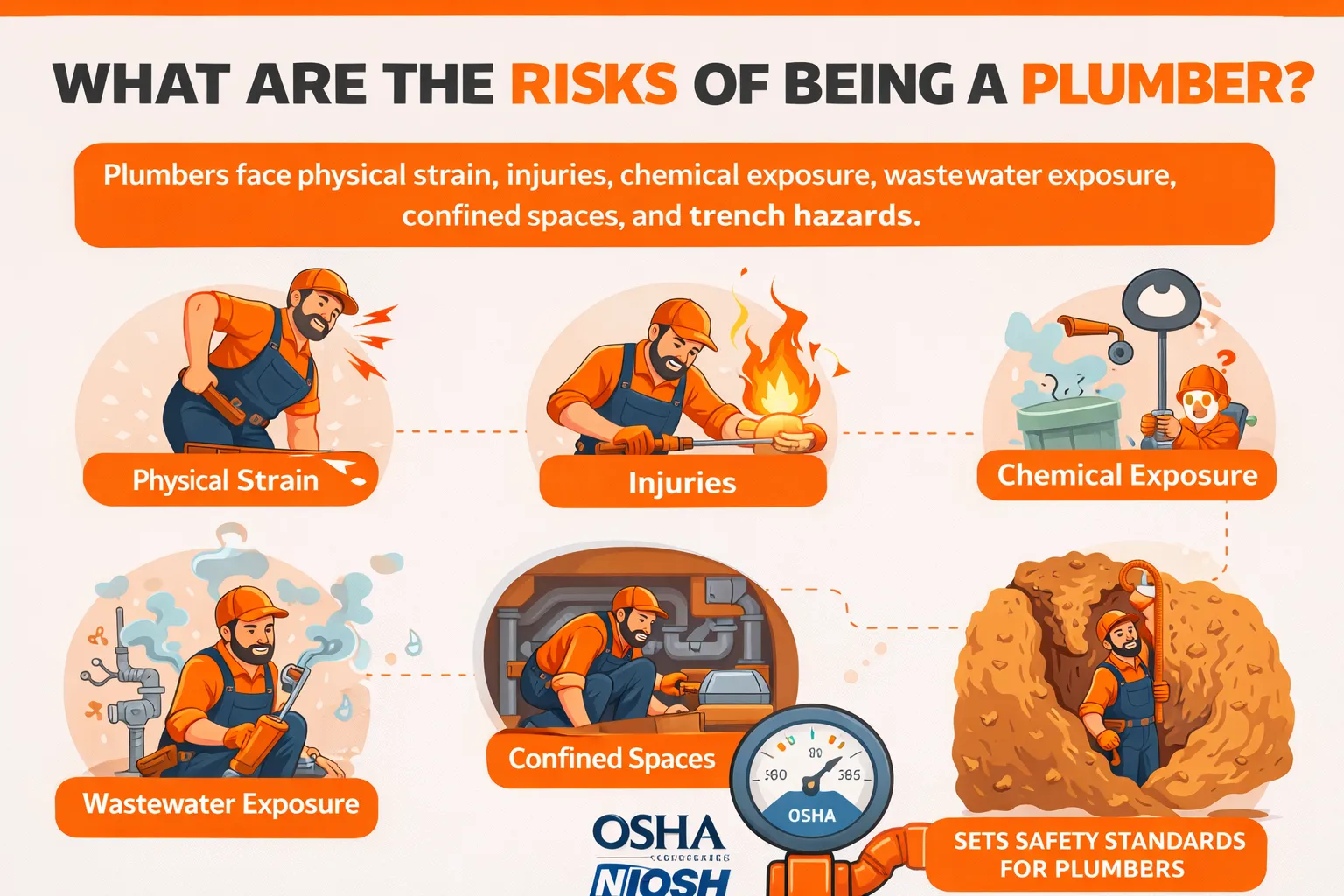
Risks of being a plumber include physical strain, tool injuries, chemical exposure, wastewater exposure, confined-space hazards, and trench hazards.
A peer-reviewed example shows how common strain injuries are in plumbing trades. Mbada, Abegunrin, Egwu, Fatoye, Moda, Falade, and Fatoye reported a 12-month prevalence of work-related musculoskeletal disorders of 84.6% among 130 Nigerian plumbers, published in PLoS ONE on October 26, 2022, with low-back symptoms as the most frequent site reported. PLOS
Risk mechanisms are documented in occupational safety literature:
NIOSH identifies heavy lifting, awkward posture, and repetitive motion as physical factors linked to work-related musculoskeletal disorders. CDC
OSHA highlights that sewer-system confined spaces can contain immediately dangerous conditions without proper identification, testing, and control. OSHA
CDC hazard alerts for sewage and wastewater facilities note hazards such as toxic gases, confined spaces, falls, and trench collapse risks during construction and maintenance work. CDC Stacks
OSHA trenching resources describe excavation and trenching as high-hazard operations, with cave-ins as a primary fatal risk. OSHA
How Do You Become A Plumber?
To become a plumber, follow 7 steps.
Finish basic schooling that supports math, reading, and technical drawing.
Take a formal skills course. TESDA Plumbing NC II amended October 2014 covers multi-unit plumbing installation with multi-point hot and cold water lines for medium-rise buildings and includes repair and maintenance work. Tesda
Train under a licensed plumber on job sites to build practical competence.
Log work experience in installation, repairs, and system testing.
Complete required safety training for construction work when applicable. Department Order No. 13 s. 1998 sets construction safety and health guidelines, and TESDA Plumbing NC II references a 40-hour construction safety course in that context. dole9portal.com
Apply for the relevant license or certification in the jurisdiction. In the Philippines, PRC regulates master plumbing under Republic Act No. 1378. Professional Regulation Commission
Maintain competence through code updates and safe work practice refreshers.
What Is The Average Salary Of A Plumber In Metro Manila?
The average salary of a plumber in Metro Manila is reported in published job-market data near PHP 19,000 to PHP 21,000 per month for Metro Manila job listings, with Manila-area averages reported near PHP 18,874 per month. Jobstreet Philippines
The table below summarizes recent published salary estimates and the measurement each source uses.
| Source | Geography | Reported pay figure | Date shown on source |
|---|---|---|---|
| Jobstreet | Metro Manila | PHP 19,000 to 21,000 per month range for average monthly salary | February 2026 Jobstreet Philippines |
| Indeed | Manila | PHP 18,874 per month average | Updated September 6, 2025 Indeed |
| Glassdoor | Manila area | PHP 20,500 per month average salary | March 2026 data label Glassdoor |
| SalaryExpert ERI | Manila | PHP 526,994 per year average | 2025 page label SalaryExpert |
How Do You Find The Right Plumber?
To find the right plumber, use checks that confirm legal compliance, competence, and clear scope and price.
A practical checklist:
Verify license or certification. PRC provides online services for license verification for regulated professions in the Philippines. Professional Regulation Commission
Request a written scope that names fixture count, pipe material, pipe size, and test method.
Request an itemized quote that separates labor, materials, and permit fees if any permits apply.
Compare 2 or 3 written quotes with identical scope.
Ask for proof of insurance or contractor registration for large jobs.
Ask for test evidence for critical work, such as a recorded pressure reading for supply piping or a drainage flow test confirmation.
Confirm warranty terms, including duration and exclusions.
Confirm work schedule, access plan, cleanup scope, and disposal of removed parts.
When Do You Call A Plumber?
Call a plumber when a plumbing system shows water escape, when drains back up, when toilets overflow repeatedly, when water pressure drops suddenly, or when a gas odor is present near gas piping.
Urgent triggers for same-day service include:
Wastewater backing up inside the building
Fast water flow from a pipe or valve fault
Water heater pressure relief discharge
No water supply to the building after a valve check
Gas odor near fuel-gas piping
Non-urgent triggers for a booked visit include:
Repeated slow drains or frequent clogs
Dripping taps, running toilets, or weak flush performance
Low pressure at multiple fixtures
Visible corrosion at a valve or fitting
Persistent sewer odor in a bathroom
For Metro Manila Plumbing service inquiries, email info@metromanilaplumbing.com.
Comments (0)
Comments are disabled.